Where Professional Services Get Procured, Not Just Referred
An online marketplace where companies hire verified audit, tax and advisory firms through a fair, open bidding process
Companies used to find audit, tax, accounting and advisory firms by asking people they knew. Now they post their requirement once, every verified firm can send a proposal, and the company picks the winner with one click.
When a company needs an auditor, a tax advisor or an accountant, it usually asks around and goes with someone it has been recommended. It rarely compares several firms side by side, even though the work always starts with a formal request describing what is needed, called a Request for Proposal (RFP). Good firms, on the other hand, struggle to be found by anyone outside their existing clients. And both sides share the same worry: is the other party a real, licensed business?
We built a marketplace that answers that worry first. Every company, every firm and every request is checked by the platform team before it goes live, and the whole process, from posting a request to choosing a firm, happens in one place. Below is how each result was achieved.
Company (the buyer)
Posts what it needs, compares the proposals it receives and chooses a firm.
Firm (the provider)
Browses open requests and sends one proposal with its price and timeline.
Admin (the platform team)
Checks every business and request, and manages prices, free trials and discounts.
- Only business email addresses are accepted, confirmed with a 6-digit code
- The list of required documents changes to match each of six supported countries
- Businesses can skip the documents step and are reminded until they finish
- One review list each for new companies, firms and requests
- Approve or reject with a written reason the applicant can read
- Changing an important detail later sends the profile back for a fresh check
- A simple form: type of service, budget, firm size wanted and deadline
- Every request is checked by the admin before firms can see it
- Firms search open requests by keyword, service, industry, country and budget
- Each firm sends one proposal per request, all in the same format
- Companies compare proposals side by side, sorted by price or timeline
- Choosing a winner closes the other proposals and tells every firm
- Firms get a free trial, then pay monthly or yearly by card (via Stripe)
- Firms update their card and download invoices themselves
- Access to requests stops automatically if there's no active trial or payment
- Change prices from a settings screen; current subscribers keep their old price
- Create discount codes and set the length of the free trial
- See monthly revenue as it's actually charged, after discounts
- Instant on-screen alerts plus an email at every important step
- A full history of past alerts, and settings to choose what you receive
- A "coming soon" page that collected interested businesses before launch
- Client reviews, partner logos and a contact form to build trust
See exactly how it works
- The five steps a request goes through, from posting to choosing a firm
- Each result explained: the problem, and what we changed to fix it
- How free trials, subscriptions and prices are managed without a developer
🔒 Kept private, never shared, no spam.
One platform, three users, five simple steps
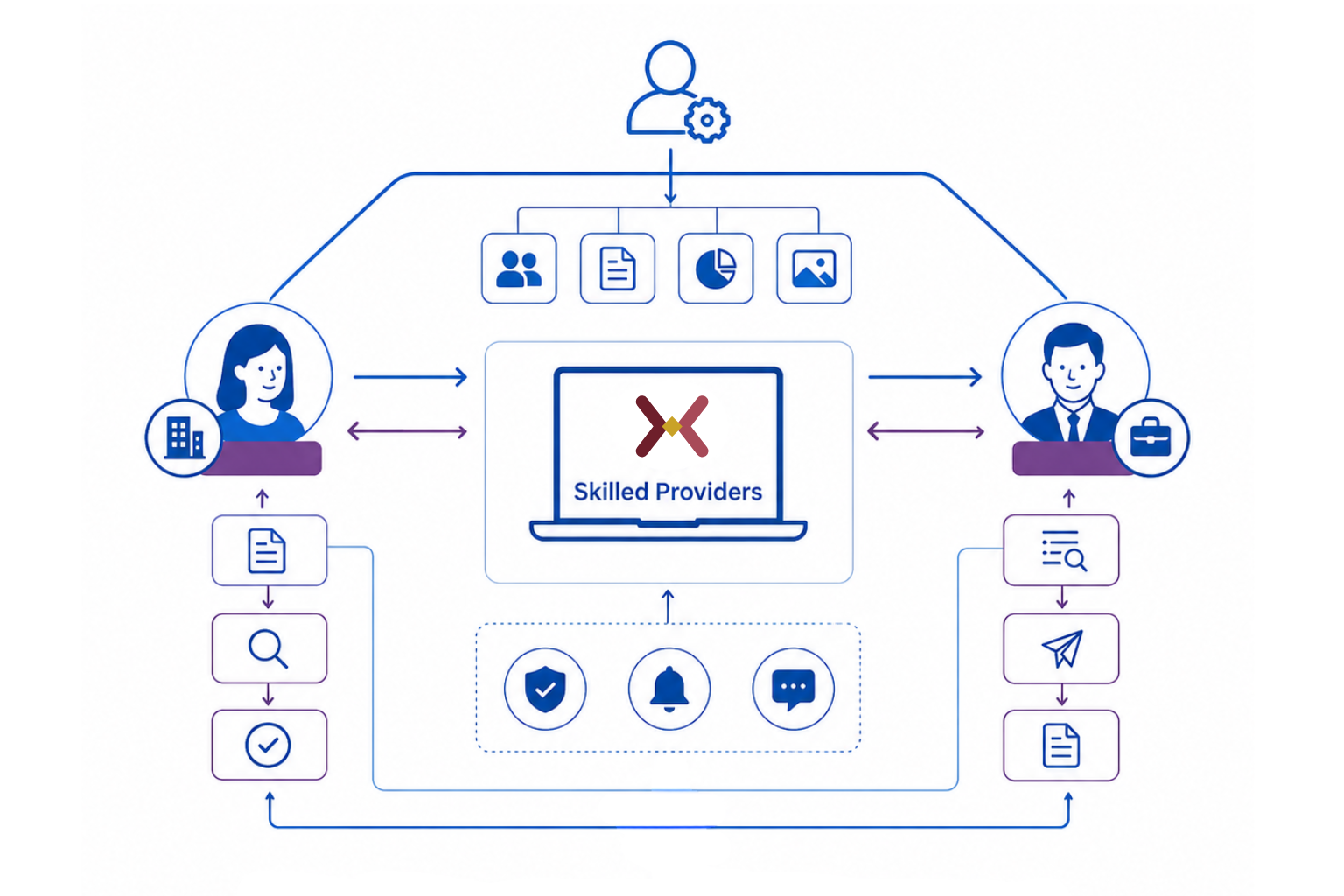
Companies, firms and the platform team all work in the same system. Every request follows the same five steps: a company posts what it needs, the admin checks it, it goes live, verified firms send proposals, and the company chooses the best one. The six results below all come from this one process.
Every business is checked before it can trade
The problem
- Companies and firms needed to know the other side was a real, licensed business.
- The only proof was a personal recommendation, which nobody could check.
- Every country asks for different registration papers, so one checklist didn't fit all.
What changed
- Sign-up only accepts business email addresses (not Gmail or Yahoo), confirmed with a 6-digit code.
- The document list matches the business's country, for example a trade registration, tax certificate and company charter, and registration numbers are checked as they are typed.
- The admin approves or rejects every business and writes the reason. If a business later changes an important detail, it is checked again.
- When a colleague joins a business that's already approved, they are linked to it by its registration number, so it never needs checking twice.
New sign-ups get an answer within 48 hours
The problem
- Checking businesses by hand only works if the team sees every new sign-up straight away, with all the papers in one place.
- Applicants who heard nothing kept emailing or gave up, and a "no" without a reason meant starting over.
What changed
- Every new sign-up appears on the admin's review list with an instant alert, showing the details and documents together.
- Approving or rejecting is a single button. A rejection must include a reason, which the applicant gets by email and on screen.
- The applicant fixes the problem on their profile and saves, and they're automatically back on the review list.
- Applicants are told about the 48-hour target as soon as they sign up, so they know what to expect.
Every request reaches every approved firm
The problem
- A company's request only reached the two or three firms someone already knew.
- Good firms were hard to find unless someone recommended them.
What changed
- The company fills in one simple form: the service it needs, what the work involves, its budget, the size of firm it wants, its industry, how the work should be delivered and the deadline.
- Once the admin approves the request, every approved firm with an active plan is alerted immediately.
- Firms search open requests by keyword, service, industry, country and budget, and choose which ones to bid on.
Compare proposals side by side and choose in one click
The problem
- Proposals arrived by email, each in a different layout, so comparing them took a long time.
- After choosing, the company had to tell every other firm one by one, and some never heard back.
What changed
- Every proposal has the same parts: price, time needed (in days), a short message, the firm's profile and the proposal document.
- Each firm can send only one proposal per request, so the comparison is always fair.
- The company sorts proposals by price or timeline and chooses the winner with one click.
- The moment a winner is chosen, all other proposals are closed and every firm is told by email and on screen.
Fewer sign-ups abandoned at the paperwork step
The problem
- The person signing up often doesn't have the company's registration papers to hand.
- Asking for every document at once made people give up, and the platform never even learned who they were.
What changed
- A "Skip for now" button lets businesses create their account first and add documents later from their profile.
- A message on their profile lists exactly which documents are still missing for their country.
- Reminders are sent 2, 5, 10 and 20 days after sign-up, by email and on screen, and stop as soon as the documents are uploaded.
- Once everything is uploaded, the profile goes to the admin for checking. Nothing unlocks until it is approved.
Prices and plans changed in minutes, without a developer
The problem
- The platform earns money from firm subscriptions, so prices, free trials and discounts change often, and every change needed a developer.
- A new price must not change what existing subscribers pay, and firms that stop paying must lose access.
What changed
- New firms get a free trial automatically. The admin chooses how long it lasts, or turns trials off.
- The admin changes monthly and yearly prices from a settings screen. Current subscribers keep paying their old price, and every change is recorded.
- The admin creates discount codes (a percentage or a fixed amount), which are checked again when the firm pays.
- Firms without an active trial or plan can't see any requests, and a failed payment shows a "Fix Payment" warning straight away.
- A dashboard shows how many firms are paying, on trial or behind on payment, plus monthly revenue after discounts.
Building a platform where trust has to come first?
Tell us about your idea. We'll help you plan how sign-up checks, approvals and payments should work, and what it takes to build them.
Where Professional Services Get Procured, Not Just Referred
An online marketplace where companies hire verified audit, tax and advisory firms through a fair, open bidding process
Companies used to find audit, tax, accounting and advisory firms by asking people they knew. Now they post their requirement once, every verified firm can send a proposal, and the company picks the winner with one click.
When a company needs an auditor, a tax advisor or an accountant, it usually asks around and goes with someone it has been recommended. It rarely compares several firms side by side, even though the work always starts with a formal request describing what is needed, called a Request for Proposal (RFP). Good firms, on the other hand, struggle to be found by anyone outside their existing clients. And both sides share the same worry: is the other party a real, licensed business?
We built a marketplace that answers that worry first. Every company, every firm and every request is checked by the platform team before it goes live, and the whole process, from posting a request to choosing a firm, happens in one place. Below is how each result was achieved.
Company (the buyer)
Posts what it needs, compares the proposals it receives and chooses a firm.
Firm (the provider)
Browses open requests and sends one proposal with its price and timeline.
Admin (the platform team)
Checks every business and request, and manages prices, free trials and discounts.
- Only business email addresses are accepted, confirmed with a 6-digit code
- The list of required documents changes to match each of six supported countries
- Businesses can skip the documents step and are reminded until they finish
- One review list each for new companies, firms and requests
- Approve or reject with a written reason the applicant can read
- Changing an important detail later sends the profile back for a fresh check
- A simple form: type of service, budget, firm size wanted and deadline
- Every request is checked by the admin before firms can see it
- Firms search open requests by keyword, service, industry, country and budget
- Each firm sends one proposal per request, all in the same format
- Companies compare proposals side by side, sorted by price or timeline
- Choosing a winner closes the other proposals and tells every firm
- Firms get a free trial, then pay monthly or yearly by card (via Stripe)
- Firms update their card and download invoices themselves
- Access to requests stops automatically if there's no active trial or payment
- Change prices from a settings screen; current subscribers keep their old price
- Create discount codes and set the length of the free trial
- See monthly revenue as it's actually charged, after discounts
- Instant on-screen alerts plus an email at every important step
- A full history of past alerts, and settings to choose what you receive
- A "coming soon" page that collected interested businesses before launch
- Client reviews, partner logos and a contact form to build trust
See exactly how it works
- The five steps a request goes through, from posting to choosing a firm
- Each result explained: the problem, and what we changed to fix it
- How free trials, subscriptions and prices are managed without a developer
🔒 Kept private, never shared, no spam.
One platform, three users, five simple steps
Companies, firms and the platform team all work in the same system. Every request follows the same five steps: a company posts what it needs, the admin checks it, it goes live, verified firms send proposals, and the company chooses the best one. The six results below all come from this one process.
Every business is checked before it can trade
The problem
- Companies and firms needed to know the other side was a real, licensed business.
- The only proof was a personal recommendation, which nobody could check.
- Every country asks for different registration papers, so one checklist didn't fit all.
What changed
- Sign-up only accepts business email addresses (not Gmail or Yahoo), confirmed with a 6-digit code.
- The document list matches the business's country, for example a trade registration, tax certificate and company charter, and registration numbers are checked as they are typed.
- The admin approves or rejects every business and writes the reason. If a business later changes an important detail, it is checked again.
- When a colleague joins a business that's already approved, they are linked to it by its registration number, so it never needs checking twice.
New sign-ups get an answer within 48 hours
The problem
- Checking businesses by hand only works if the team sees every new sign-up straight away, with all the papers in one place.
- Applicants who heard nothing kept emailing or gave up, and a "no" without a reason meant starting over.
What changed
- Every new sign-up appears on the admin's review list with an instant alert, showing the details and documents together.
- Approving or rejecting is a single button. A rejection must include a reason, which the applicant gets by email and on screen.
- The applicant fixes the problem on their profile and saves, and they're automatically back on the review list.
- Applicants are told about the 48-hour target as soon as they sign up, so they know what to expect.
Every request reaches every approved firm
The problem
- A company's request only reached the two or three firms someone already knew.
- Good firms were hard to find unless someone recommended them.
What changed
- The company fills in one simple form: the service it needs, what the work involves, its budget, the size of firm it wants, its industry, how the work should be delivered and the deadline.
- Once the admin approves the request, every approved firm with an active plan is alerted immediately.
- Firms search open requests by keyword, service, industry, country and budget, and choose which ones to bid on.
Compare proposals side by side and choose in one click
The problem
- Proposals arrived by email, each in a different layout, so comparing them took a long time.
- After choosing, the company had to tell every other firm one by one, and some never heard back.
What changed
- Every proposal has the same parts: price, time needed (in days), a short message, the firm's profile and the proposal document.
- Each firm can send only one proposal per request, so the comparison is always fair.
- The company sorts proposals by price or timeline and chooses the winner with one click.
- The moment a winner is chosen, all other proposals are closed and every firm is told by email and on screen.
Fewer sign-ups abandoned at the paperwork step
The problem
- The person signing up often doesn't have the company's registration papers to hand.
- Asking for every document at once made people give up, and the platform never even learned who they were.
What changed
- A "Skip for now" button lets businesses create their account first and add documents later from their profile.
- A message on their profile lists exactly which documents are still missing for their country.
- Reminders are sent 2, 5, 10 and 20 days after sign-up, by email and on screen, and stop as soon as the documents are uploaded.
- Once everything is uploaded, the profile goes to the admin for checking. Nothing unlocks until it is approved.
Prices and plans changed in minutes, without a developer
The problem
- The platform earns money from firm subscriptions, so prices, free trials and discounts change often, and every change needed a developer.
- A new price must not change what existing subscribers pay, and firms that stop paying must lose access.
What changed
- New firms get a free trial automatically. The admin chooses how long it lasts, or turns trials off.
- The admin changes monthly and yearly prices from a settings screen. Current subscribers keep paying their old price, and every change is recorded.
- The admin creates discount codes (a percentage or a fixed amount), which are checked again when the firm pays.
- Firms without an active trial or plan can't see any requests, and a failed payment shows a "Fix Payment" warning straight away.
- A dashboard shows how many firms are paying, on trial or behind on payment, plus monthly revenue after discounts.
Building a platform where trust has to come first?
Tell us about your idea. We'll help you plan how sign-up checks, approvals and payments should work, and what it takes to build them.