The Deadline That Belonged to Everyone — and No One
Full-Scale Odoo ERP for Project Lifecycle, Job Costing & Field Operations
Every department assumed someone else was tracking it. A fixed SOP made sure that never happens again.
Run a multi-discipline MEP project long enough and you'll notice the pattern: no single department drops the ball — the ball just doesn't have anywhere to land between them. Tendering assumes Procurement is tracking a deadline. Procurement assumes Finance already saw it. Nobody's wrong. Nothing's tracked.
For one multi-regional MEP and vertical-transport contractor running six departments across three regions, that pattern ran the show — until a fixed SOP connected tender to close-out into a single thread. Here's where the deadlines used to disappear, and what closes the gap now.
Applications Implemented
- Accounting & Invoicing
- CRM, Sales & Marketing Automation
- WhatsApp & Social Marketing
- Purchase, Inventory & Barcode
- Employee, Payroll & Recruitment
- Projects & Field Service
- Helpdesk & Repair Management
- Custom Dashboards & Reports
Key Business Processes
- Quotation & Auto Follow-up
- Payment Approvals (Vendor, Payroll)
- Project Lifecycle Management
- Tender & Bank Guarantee Tracking
- SLA & Preventive Maintenance
- Field Service Inventory
- Website Appointment Booking
- Sales Team Targets & Reports
See the exact SOP
- How six departments run on one deadline structure, stage by stage
- Where EM, BG, and CDR tracking plugs into the workflow
- How daily KPIs roll up without anyone assembling them by hand
🔒 Kept private, never shared, no spam.
Day to day, the pattern looked like this
- Tendering, Sales, Project Management, Procurement, Finance, and HR each ran on their own tools, disconnected from each other.
- Nothing forced a deadline to be visible outside the department that owned it.
- A tender bid submission, a follow-up, a document — could slip through simply because no one else was watching for it.
What changed
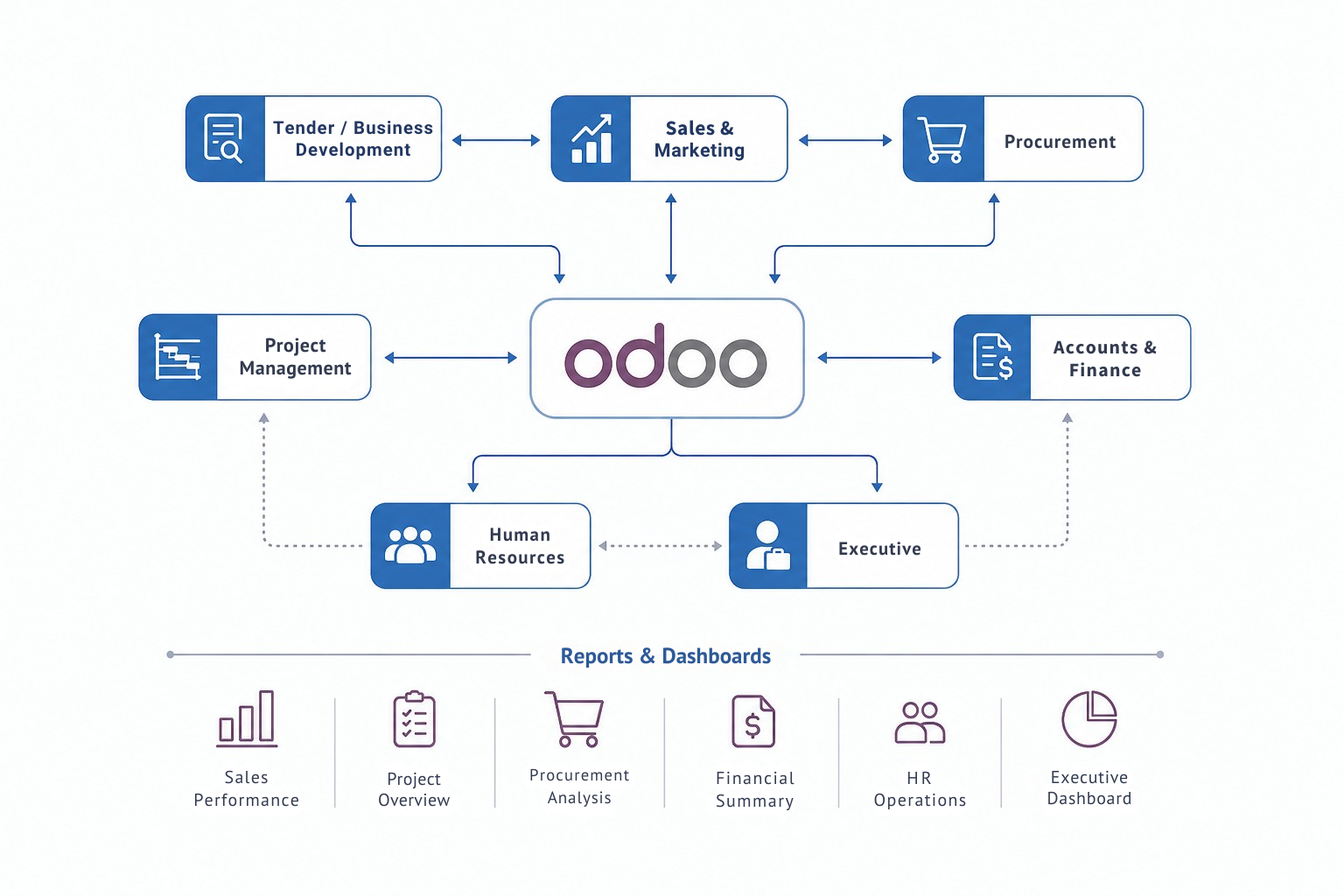
We implemented one system that follows a project through its entire lifecycle — tender and bidding, award and contract, mobilization, procurement and execution, billing and collection, close-out — as a single connected thread:
The outcome
One SOP, one deadline structure, for every process — across six lifecycle stages, eight service domains, and three regions. Leadership now has one place to see exactly where any tender or project stands.
Coordinating a multi-discipline project across departments that don't share a deadline?
Let's map where handoffs are slipping between departments — and what it takes to run every project on one SOP.
The Deadline That Belonged to Everyone — and No One
Full-Scale Odoo ERP for Project Lifecycle, Job Costing & Field Operations
Every department assumed someone else was tracking it. A fixed SOP made sure that never happens again.
Run a multi-discipline MEP project long enough and you'll notice the pattern: no single department drops the ball — the ball just doesn't have anywhere to land between them. Tendering assumes Procurement is tracking a deadline. Procurement assumes Finance already saw it. Nobody's wrong. Nothing's tracked.
For one multi-regional MEP and vertical-transport contractor running six departments across three regions, that pattern ran the show — until a fixed SOP connected tender to close-out into a single thread. Here's where the deadlines used to disappear, and what closes the gap now.
Applications Implemented
- Accounting & Invoicing
- CRM, Sales & Marketing Automation
- WhatsApp & Social Marketing
- Purchase, Inventory & Barcode
- Employee, Payroll & Recruitment
- Projects & Field Service
- Helpdesk & Repair Management
- Custom Dashboards & Reports
Key Business Processes
- Quotation & Auto Follow-up
- Payment Approvals (Vendor, Payroll)
- Project Lifecycle Management
- Tender & Bank Guarantee Tracking
- SLA & Preventive Maintenance
- Field Service Inventory
- Website Appointment Booking
- Sales Team Targets & Reports
See the exact SOP
- How six departments run on one deadline structure, stage by stage
- Where EM, BG, and CDR tracking plugs into the workflow
- How daily KPIs roll up without anyone assembling them by hand
🔒 Kept private, never shared, no spam.
Day to day, the pattern looked like this
- Tendering, Sales, Project Management, Procurement, Finance, and HR each ran on their own tools, disconnected from each other.
- Nothing forced a deadline to be visible outside the department that owned it.
- A tender bid submission, a follow-up, a document — could slip through simply because no one else was watching for it.
What changed
We implemented one system that follows a project through its entire lifecycle — tender and bidding, award and contract, mobilization, procurement and execution, billing and collection, close-out — as a single connected thread:
The outcome
One SOP, one deadline structure, for every process — across six lifecycle stages, eight service domains, and three regions. Leadership now has one place to see exactly where any tender or project stands.
Coordinating a multi-discipline project across departments that don't share a deadline?
Let's map where handoffs are slipping between departments — and what it takes to run every project on one SOP.