Live Margins. One Inventory. Automated Payroll.
Phased Odoo ERP for Food Manufacturing, Showroom Operations & Workforce
Finance, production, the showroom and payroll now run on one live system — the same stock and cost picture from raw material to finished goods to the till.
Outcomes
For a manufacturer that also sells through its own showroom, the same split tends to appear: production, retail and HR each keep their own picture of the business. Stock lives in more than one place, production costs reach the ledgers after the fact, and payroll depends on someone turning attendance into salary by hand.
For one coffee manufacturer with its own showroom, that split closed in two phases — finance, production, POS and workforce now run on one live Odoo ERP, and POS, warehouse and manufacturing read from the same inventory picture. Here's what the business needed, what was built in each phase, and what it gives them now.
What Was Implemented
- Accounts and taxes set up for local requirements
- Custom tax, ledger and payables/receivables reporting
- Multi-level BoMs for roast and blend products, packaging and finished goods
- MO lifecycle from raw-material draw-down to production output
- Stock movements map to the ledger automatically
- Production costs flow into the ledgers, live margin per batch
- Reorder rules trigger purchasing before stockouts
- Live stock reporting across raw material, WIP, wastage and packing
- Purchase and vendor management
- Sales and invoicing
- Expense approval workflows
- Custom scannable product and location barcodes, instant lookups at the till
- Daily POS sessions with reconciliation and cashier/manager roles
- Best-seller data visible in real time
- Employee records, ID badges and org hierarchy
- Contracts, onboarding and offboarding, leave and appraisals
- Check-in and check-out recorded in the system
- Grace periods and overtime rules feed salary structures
- Payslip batches replace manual calculation
See how it was built
- How BoMs, manufacturing orders and replenishment feed the ledger
- How POS, warehouse and production read from one live inventory picture
- How attendance, grace periods and overtime flow into payroll
🔒 Kept private, never shared, no spam.
One Odoo system, delivered in two phases
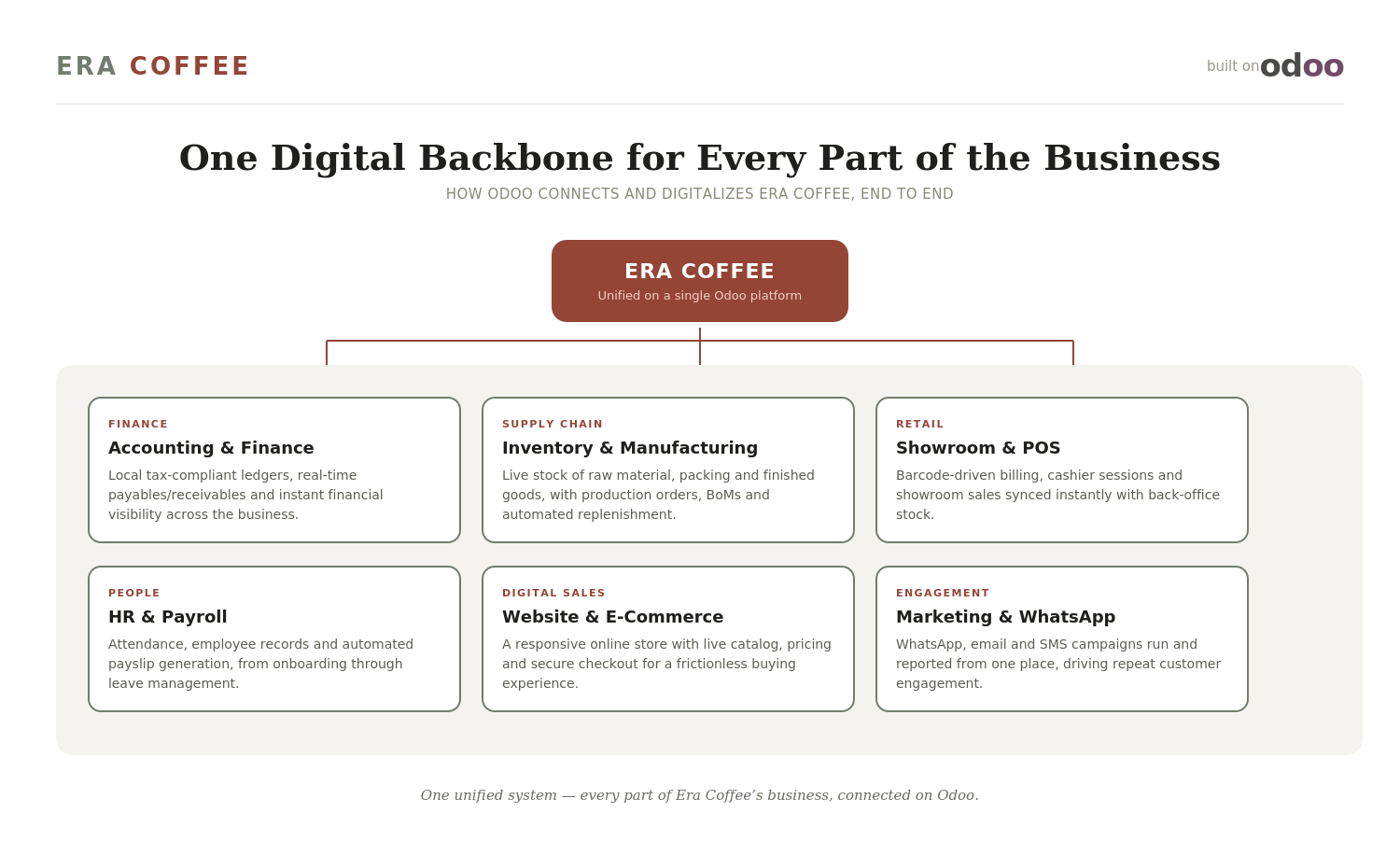
We delivered one Odoo system in two phases. Phase 1 built the core operations backbone: finance, manufacturing, inventory and purchasing. Phase 2 put the showroom and the workforce on top of it, so every function reads from the same records. Nine outcomes came out of it.
Live margin on every batch
The problem. Production costs reached the ledgers after the fact, so the margin on a batch was only known later.
What changed. Multi-level BoMs cover roast and blend products, packaging and finished goods. Each manufacturing order is tracked from raw-material draw-down to production output, and production costs flow directly into the ledgers, giving a live margin per batch.
Real-time financial visibility
The problem. Finance, production, retail and HR each kept their own picture of the business.
What changed. The chart of accounts and local taxation are set up once, and inventory maps to the ledger automatically. Leadership sees financial position in real time across all ledgers, with custom tax, ledger and payables/receivables reporting.
Raw material reordered before stockouts
The problem. Reordering depended on someone noticing that raw material was running low.
What changed. Reorder rules trigger purchasing before a raw-material stockout occurs, and purchase and vendor management run on the same records.
One live inventory picture
The problem. Stock lived in more than one place: the warehouse, the production floor and the showroom till each had their own view.
What changed. Custom scannable barcodes for products and locations give instant lookups at the till. POS, warehouse and manufacturing now read from one live inventory picture, with live stock reporting across raw material, WIP, wastage and packing.
Best-sellers visible as they sell
The problem. Showroom sales were not visible in time to guide what to restock.
What changed. Daily POS sessions are reconciled under cashier and manager roles, and showroom sales data, including best-sellers, is visible in real time to guide restocking decisions.
Payslips run from attendance
The problem. Payroll depended on someone turning attendance into salary by hand.
What changed. Check-in and check-out, grace periods and overtime rules feed directly into salary structures and payslip batches, so attendance-linked salary runs replace manual calculation.
One system from hiring to appraisal
The problem. HR records sat apart from the rest of the business.
What changed. Employee records, ID badges, org hierarchy, contracts, onboarding and offboarding, leave and appraisals now live in the same system as attendance and payroll.
Full audit trail on every change
The problem. Changes to records could not be traced reliably across separate tools.
What changed. Every record change is tracked in a full audit trail, and expenses go through approval workflows before they are posted.
Built lean on standard Odoo
The problem. Heavy custom development adds cost and makes long-term maintenance harder.
What changed. Every requirement was mapped to standard Odoo or Studio low-code, with no custom Python and no Odoo.sh dependency, which keeps deployment and long-term maintenance simple. Anything needing custom code is documented and scoped separately.
Two phases live, one to go
Phases 1 and 2 are complete and running. With the operational backbone in place, a third phase covering website, e-commerce, WhatsApp and marketing automation is next.
Running a factory, a showroom and payroll on separate tools?
Let's map where production, retail and HR stop sharing the same records — and what it takes to put them on one system.
Live Margins. One Inventory. Automated Payroll.
Phased Odoo ERP for Food Manufacturing, Showroom Operations & Workforce
Finance, production, the showroom and payroll now run on one live system — the same stock and cost picture from raw material to finished goods to the till.
Outcomes
For a manufacturer that also sells through its own showroom, the same split tends to appear: production, retail and HR each keep their own picture of the business. Stock lives in more than one place, production costs reach the ledgers after the fact, and payroll depends on someone turning attendance into salary by hand.
For one coffee manufacturer with its own showroom, that split closed in two phases — finance, production, POS and workforce now run on one live Odoo ERP, and POS, warehouse and manufacturing read from the same inventory picture. Here's what the business needed, what was built in each phase, and what it gives them now.
What Was Implemented
- Accounts and taxes set up for local requirements
- Custom tax, ledger and payables/receivables reporting
- Multi-level BoMs for roast and blend products, packaging and finished goods
- MO lifecycle from raw-material draw-down to production output
- Stock movements map to the ledger automatically
- Production costs flow into the ledgers, live margin per batch
- Reorder rules trigger purchasing before stockouts
- Live stock reporting across raw material, WIP, wastage and packing
- Purchase and vendor management
- Sales and invoicing
- Expense approval workflows
- Custom scannable product and location barcodes, instant lookups at the till
- Daily POS sessions with reconciliation and cashier/manager roles
- Best-seller data visible in real time
- Employee records, ID badges and org hierarchy
- Contracts, onboarding and offboarding, leave and appraisals
- Check-in and check-out recorded in the system
- Grace periods and overtime rules feed salary structures
- Payslip batches replace manual calculation
See how it was built
- How BoMs, manufacturing orders and replenishment feed the ledger
- How POS, warehouse and production read from one live inventory picture
- How attendance, grace periods and overtime flow into payroll
🔒 Kept private, never shared, no spam.
One Odoo system, delivered in two phases
We delivered one Odoo system in two phases. Phase 1 built the core operations backbone: finance, manufacturing, inventory and purchasing. Phase 2 put the showroom and the workforce on top of it, so every function reads from the same records. Nine outcomes came out of it.
Live margin on every batch
The problem. Production costs reached the ledgers after the fact, so the margin on a batch was only known later.
What changed. Multi-level BoMs cover roast and blend products, packaging and finished goods. Each manufacturing order is tracked from raw-material draw-down to production output, and production costs flow directly into the ledgers, giving a live margin per batch.
Real-time financial visibility
The problem. Finance, production, retail and HR each kept their own picture of the business.
What changed. The chart of accounts and local taxation are set up once, and inventory maps to the ledger automatically. Leadership sees financial position in real time across all ledgers, with custom tax, ledger and payables/receivables reporting.
Raw material reordered before stockouts
The problem. Reordering depended on someone noticing that raw material was running low.
What changed. Reorder rules trigger purchasing before a raw-material stockout occurs, and purchase and vendor management run on the same records.
One live inventory picture
The problem. Stock lived in more than one place: the warehouse, the production floor and the showroom till each had their own view.
What changed. Custom scannable barcodes for products and locations give instant lookups at the till. POS, warehouse and manufacturing now read from one live inventory picture, with live stock reporting across raw material, WIP, wastage and packing.
Best-sellers visible as they sell
The problem. Showroom sales were not visible in time to guide what to restock.
What changed. Daily POS sessions are reconciled under cashier and manager roles, and showroom sales data, including best-sellers, is visible in real time to guide restocking decisions.
Payslips run from attendance
The problem. Payroll depended on someone turning attendance into salary by hand.
What changed. Check-in and check-out, grace periods and overtime rules feed directly into salary structures and payslip batches, so attendance-linked salary runs replace manual calculation.
One system from hiring to appraisal
The problem. HR records sat apart from the rest of the business.
What changed. Employee records, ID badges, org hierarchy, contracts, onboarding and offboarding, leave and appraisals now live in the same system as attendance and payroll.
Full audit trail on every change
The problem. Changes to records could not be traced reliably across separate tools.
What changed. Every record change is tracked in a full audit trail, and expenses go through approval workflows before they are posted.
Built lean on standard Odoo
The problem. Heavy custom development adds cost and makes long-term maintenance harder.
What changed. Every requirement was mapped to standard Odoo or Studio low-code, with no custom Python and no Odoo.sh dependency, which keeps deployment and long-term maintenance simple. Anything needing custom code is documented and scoped separately.
Two phases live, one to go
Phases 1 and 2 are complete and running. With the operational backbone in place, a third phase covering website, e-commerce, WhatsApp and marketing automation is next.
Running a factory, a showroom and payroll on separate tools?
Let's map where production, retail and HR stop sharing the same records — and what it takes to put them on one system.