Five Sites. One System. Zero Friction.
Project-Based Odoo ERP with Real-Time Procurement-to-Payment Visibility
QuickBooks on one site, Excel on another, paper elsewhere — and a phone call whenever Head Office needed an answer. Now five sites and Head Office see what's owed at the same time.
In construction, the same failure shows up on almost every multi-site operation: each site runs its own tools — QuickBooks on one, Excel on another, paper elsewhere — and none of it reaches Head Office directly, so finding out what's owed means picking up the phone. A short delivery gets forgotten instead of chased. A subcontractor's claim becomes a manual argument over retention and past payments. Withholding tax gets applied inconsistently, depending on who's doing the math that day.
For one multi-site contractor, that gap closed entirely — all five sites and Head Office now work from the same live system, and what a site owes reads the same in both places, at the same time. Here's exactly how, and what it took to get there.
- Request signed by the Project Manager before it can be submitted
- Procurement HO review against stock and budget
- Vendors compared side by side, Procurement Head signs off first
- CEO approves line by line: full, partial or a set quantity
- PO locks the moment it is approved
- Automatic backorder for the balance of a short delivery
- No payable created until a claim or bill arrives
- Backcharge posts as a journal entry on issuance
- Reverses automatically when material is returned
- Vendor claims booked at the gross amount
- IPC nets retention, backcharges and past payments automatically
- CEO approval locks the net payable
- Withholding tax calculated once, at Finance HO payment
- Cheque numbers come from the bank's range and can't be reused
- Cheques print in the layout of the bank's own chequebook
- One chart of accounts, scoped by project
- Site accountants see only their own project
- Group-level accounts blocked from direct postings
- Trial Balance, General Ledger and Partner Ledger locked to the project
- Liabilities, bank balances and inventory live, by project and period
- "All Time" view back to day one
See the exact workflow
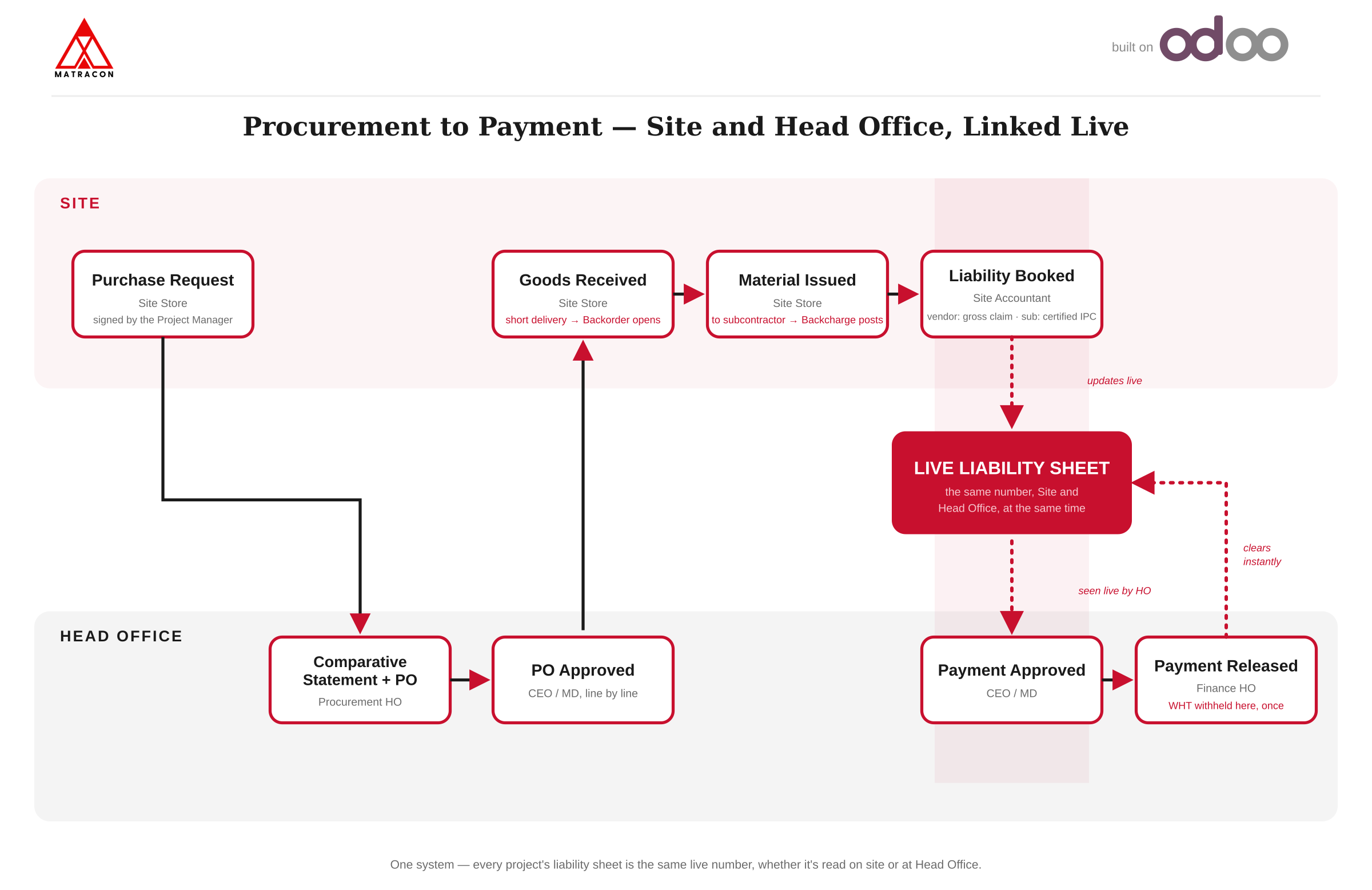
- The five-role chain a request follows, from site store to payment
- How each outcome was achieved, with the problem and the fix side by side
- A real quote from the client's Director of Procurement
🔒 Kept private, never shared, no spam.
One system, five roles, every site
We built one Odoo-based system, live for every site and Head Office at the same time. Every purchase — from a request raised at a site to a payment released by Head Office — passes through five roles (Site Store, Procurement HO, CEO, Site Accountant and Finance HO) and lands in the same books. Nine outcomes came out of it.
One live view of every project
The problem. Every site kept its own records — QuickBooks on one, Excel on another, paper elsewhere — and none of it reached Head Office directly, so Head Office learned where things stood after the fact, by phone.
What changed. Head Office sees inventory, liabilities and cash position for all projects as they happen, not after the fact. Site teams see only their own project, while the Head Office roles see them all.
Liability sheets in minutes, not days
The problem. Liability sheets had to be compiled by hand, which took days.
What changed. Payables generate automatically from the ledger. The team only verifies and recommends; they no longer compile.
Subcontractor IPCs certified within a day
The problem. Subcontractor billing was a manual argument: work done, retention and past payments were recalculated by hand on every bill.
What changed. The Site Accountant enters work done against each BOQ item in an IPC. Retention, backcharges and past payments net automatically, and the CEO's approval locks the net payable.
Tax handled once, correctly
The problem. Withholding tax was applied at four separate points, and it was easy to miss or miscalculate whenever it wasn't automatic.
What changed. Withholding tax now applies at a single point, at payment by Finance HO, and the deduction certificate is generated automatically each time.
Comparative statements within a single day
The problem. Comparing vendors before a purchase meant days of manual spreadsheet work.
What changed. A purchase request is signed by the Project Manager, and Procurement HO checks it against stock and budget. Vendor quotes then compare side by side automatically. The Procurement Head signs off first, and the CEO approves the PO line by line, after which it locks.
Batch payments in minutes instead of hours
The problem. Vendor payments were approved and processed one at a time, which took hours.
What changed. Many vendor payments are approved and processed in one run, with cheques printed straight from the system.
Petty cash under control on every site
The problem. Petty cash on each site had no consistent approval step, and expenses were not reliably posted with their bills.
What changed. Requests are approved by the CEO before cash is released. Every expense is posted with its bill attached, and a journal entry is created automatically. Each site's fund balance is live from the ledger.
No lost deliveries, no duplicate cheques
The problem. A short delivery got forgotten instead of chased, because nothing flagged what was still owed on the order, and a cheque number could be issued twice.
What changed. Every short delivery becomes a tracked backorder, linked to the original PO until it clears. Cheque numbers lock once used, preventing duplicate issuance.
Growth without new development
The problem. Many business documents lived on paper or in email, and every new project meant more of that manual setup.
What changed. A new project is added through configuration with zero code changes, and 27 business documents that used to be on paper or email now print directly from the system.
Live in production today
The system is live across five sites, each with its own store and accountant, and the same logic extends as new projects come online. Work now is about deepening it: sharper edges as everyday use turns up gaps, and better reporting for whoever is watching cost and progress.
Running more than one site and still chasing this answer by phone?
Let's map where your sites and Head Office lose visibility — and what it takes to close the gap.
Five Sites. One System. Zero Friction.
Project-Based Odoo ERP with Real-Time Procurement-to-Payment Visibility
QuickBooks on one site, Excel on another, paper elsewhere — and a phone call whenever Head Office needed an answer. Now five sites and Head Office see what's owed at the same time.
In construction, the same failure shows up on almost every multi-site operation: each site runs its own tools — QuickBooks on one, Excel on another, paper elsewhere — and none of it reaches Head Office directly, so finding out what's owed means picking up the phone. A short delivery gets forgotten instead of chased. A subcontractor's claim becomes a manual argument over retention and past payments. Withholding tax gets applied inconsistently, depending on who's doing the math that day.
For one multi-site contractor, that gap closed entirely — all five sites and Head Office now work from the same live system, and what a site owes reads the same in both places, at the same time. Here's exactly how, and what it took to get there.
- Request signed by the Project Manager before it can be submitted
- Procurement HO review against stock and budget
- Vendors compared side by side, Procurement Head signs off first
- CEO approves line by line: full, partial or a set quantity
- PO locks the moment it is approved
- Automatic backorder for the balance of a short delivery
- No payable created until a claim or bill arrives
- Backcharge posts as a journal entry on issuance
- Reverses automatically when material is returned
- Vendor claims booked at the gross amount
- IPC nets retention, backcharges and past payments automatically
- CEO approval locks the net payable
- Withholding tax calculated once, at Finance HO payment
- Cheque numbers come from the bank's range and can't be reused
- Cheques print in the layout of the bank's own chequebook
- One chart of accounts, scoped by project
- Site accountants see only their own project
- Group-level accounts blocked from direct postings
- Trial Balance, General Ledger and Partner Ledger locked to the project
- Liabilities, bank balances and inventory live, by project and period
- "All Time" view back to day one
See the exact workflow
- The five-role chain a request follows, from site store to payment
- How each outcome was achieved, with the problem and the fix side by side
- A real quote from the client's Director of Procurement
🔒 Kept private, never shared, no spam.
One system, five roles, every site
We built one Odoo-based system, live for every site and Head Office at the same time. Every purchase — from a request raised at a site to a payment released by Head Office — passes through five roles (Site Store, Procurement HO, CEO, Site Accountant and Finance HO) and lands in the same books. Nine outcomes came out of it.
One live view of every project
The problem. Every site kept its own records — QuickBooks on one, Excel on another, paper elsewhere — and none of it reached Head Office directly, so Head Office learned where things stood after the fact, by phone.
What changed. Head Office sees inventory, liabilities and cash position for all projects as they happen, not after the fact. Site teams see only their own project, while the Head Office roles see them all.
Liability sheets in minutes, not days
The problem. Liability sheets had to be compiled by hand, which took days.
What changed. Payables generate automatically from the ledger. The team only verifies and recommends; they no longer compile.
Subcontractor IPCs certified within a day
The problem. Subcontractor billing was a manual argument: work done, retention and past payments were recalculated by hand on every bill.
What changed. The Site Accountant enters work done against each BOQ item in an IPC. Retention, backcharges and past payments net automatically, and the CEO's approval locks the net payable.
Tax handled once, correctly
The problem. Withholding tax was applied at four separate points, and it was easy to miss or miscalculate whenever it wasn't automatic.
What changed. Withholding tax now applies at a single point, at payment by Finance HO, and the deduction certificate is generated automatically each time.
Comparative statements within a single day
The problem. Comparing vendors before a purchase meant days of manual spreadsheet work.
What changed. A purchase request is signed by the Project Manager, and Procurement HO checks it against stock and budget. Vendor quotes then compare side by side automatically. The Procurement Head signs off first, and the CEO approves the PO line by line, after which it locks.
Batch payments in minutes instead of hours
The problem. Vendor payments were approved and processed one at a time, which took hours.
What changed. Many vendor payments are approved and processed in one run, with cheques printed straight from the system.
Petty cash under control on every site
The problem. Petty cash on each site had no consistent approval step, and expenses were not reliably posted with their bills.
What changed. Requests are approved by the CEO before cash is released. Every expense is posted with its bill attached, and a journal entry is created automatically. Each site's fund balance is live from the ledger.
No lost deliveries, no duplicate cheques
The problem. A short delivery got forgotten instead of chased, because nothing flagged what was still owed on the order, and a cheque number could be issued twice.
What changed. Every short delivery becomes a tracked backorder, linked to the original PO until it clears. Cheque numbers lock once used, preventing duplicate issuance.
Growth without new development
The problem. Many business documents lived on paper or in email, and every new project meant more of that manual setup.
What changed. A new project is added through configuration with zero code changes, and 27 business documents that used to be on paper or email now print directly from the system.
Live in production today
The system is live across five sites, each with its own store and accountant, and the same logic extends as new projects come online. Work now is about deepening it: sharper edges as everyday use turns up gaps, and better reporting for whoever is watching cost and progress.
Running more than one site and still chasing this answer by phone?
Let's map where your sites and Head Office lose visibility — and what it takes to close the gap.